As baseline artificial intelligence becomes a commodity, software and automation are no longer scarce resources. So, where does the next decade of enterprise advantage come from?
The companies with the upper hand will be the ones that understand, in granular detail, how they convert inputs into outputs. How they buy, make, and sell. This understanding — or decision intelligence — is the only unique value a business has left.
Since the end of the industrial revolution, businesses have more or less been structured the same way: independent functions, with layers of hierarchy responsible for coordination between them.
This organizational design was the first form of enterprise information technology; it was the means by which we stored, processed, and shared information. Middle management was the middleware, making the org chart the machine for routing information that could not flow on its own.
Today, this design has hit its limits. Information sits across dozens of systems, owned by different functions, with no common language and no obligation to reconcile. Finance works from one version of the truth, procurement from another, operations from a third, and aligning those versions has become a job in itself.
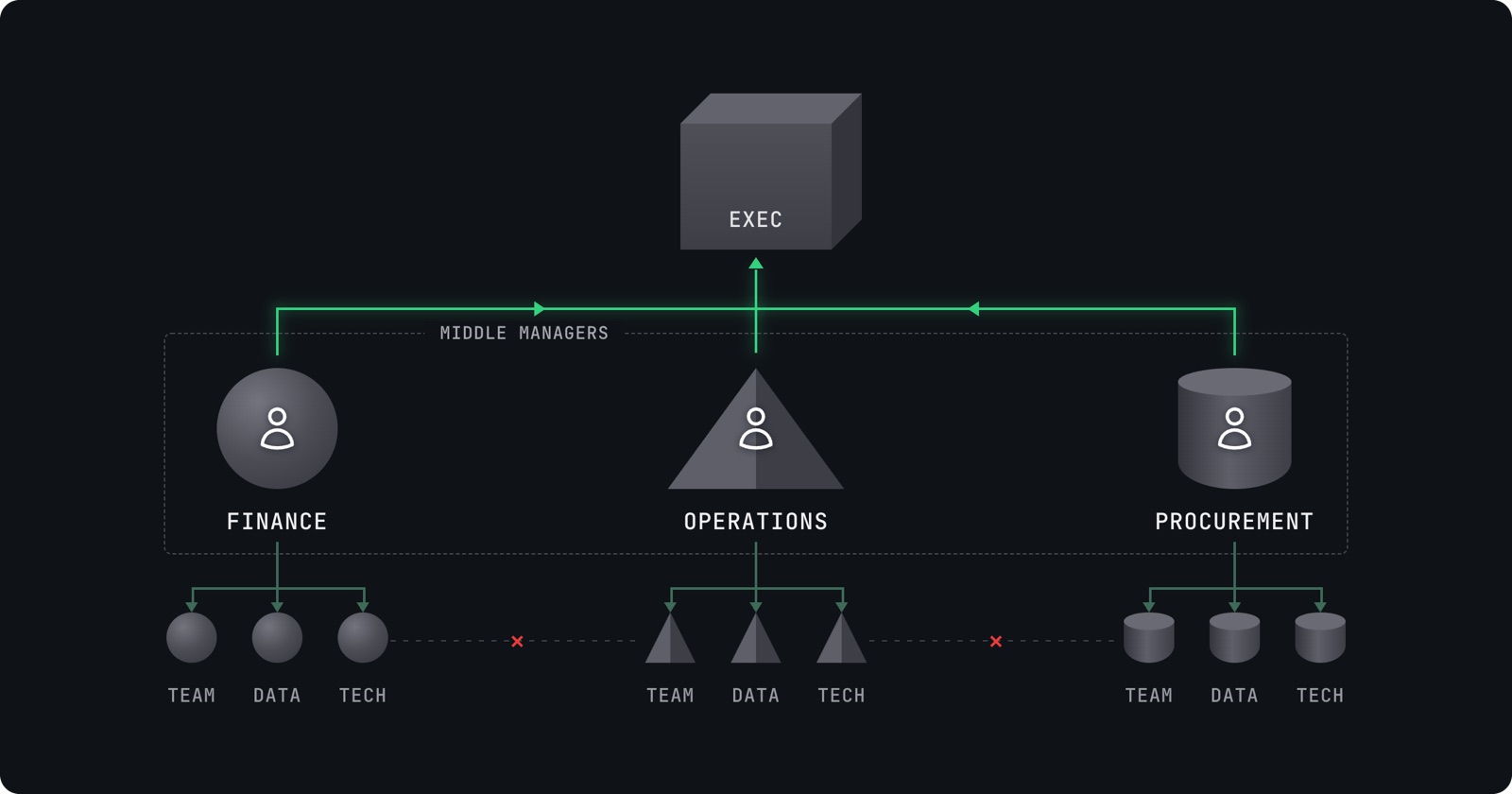
So, most work in the modern enterprise is now administrative. We spend more time managing this problem (and communicating around it) than working together to create value.
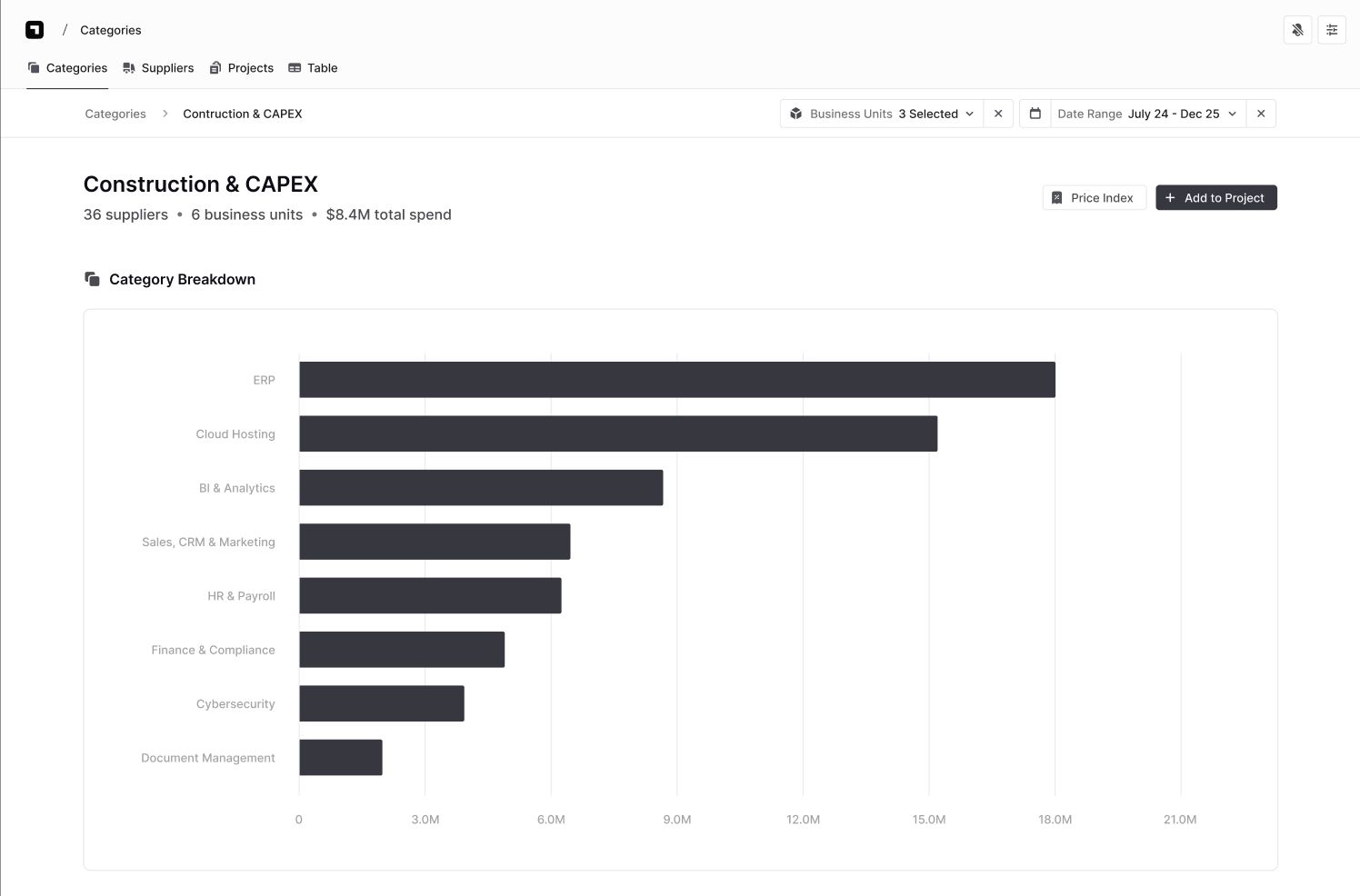
Most large companies have spent several decades trying to fix the visible parts of this issue. They have run transformation programs to consolidate reporting, and stood up ✨dashboards✨ to more reliably answer what has happened across the business.
Behind them, BI teams stitch tools together against an ever-growing queue of tickets. One procurement leader I spoke with, forty years in the job, ran a twenty-person team costing over half a million a year, to answer questions the company could not otherwise answer about itself.
This is not an isolated experience. Some version of that team exists in every large enterprise, producing descriptive analytics: a clearer view of the past. Many leadership teams have now come to realize that they are essentially paying for an expensive rear-view mirror. If you can only describe what has already happened, you're only ever looking backwards, even with every dashboard in the world.
For forward-looking planning, many companies hire consultants to help deliver a strategic plan. However, the value of external help is rarely that they know more about your business than you do. Instead, you're investing in the weeks of effort required to access the data, make sense of it, and align the team around what it means.
A third party's ability to force coordination, and to recognize patterns from inside your business and beyond it, is usually worth paying for. But, beyond a polished slide deck containing a static data snapshot, that value walks out the door the moment the engagement ends.
Where do we go from here? The good news is that recent technological advancements in LLMs and search and retrieval tooling allow us to solve the information challenge at an unprecedented scale. Previous attempts to unify enterprise information ran on rigid rules that broke on contact with edge cases and exceptions, whereas language models are able to understand nuance, and adapt output based on changing context.
Messy data is no longer the blocker. A business can now hold a real-time understanding of itself in an enterprise brain. It consists of long-term memory that compounds and unifies everything the business knows about itself, across every function. At the same time, it can pull that context into working memory, so it delivers the right information to the right person at the moment of decision.
Analyses that took a team six weeks now take a morning, and can be done independently. Answering questions like: "How much did we spend on packaging last quarter?" is no longer the hard part, it is the floor of what is now possible. Teams can ask more complex, multivariate questions like "If oil holds at this level, what are the knock-on effects across our supply chain? Which suppliers should we move to, and which will be irrelevant in eighteen months?"
Decision intelligence is the foundation of any meaningful transformation effort and provides the answer to "what does this mean?" and "what should we do about it?"
Instead of the rear-view mirror of a data dashboard, you can have a live satellite map to guide you through each decision in real time, getting you to the desired outcome via the quickest and easiest route.
So, if analytics is a product category you buy, intelligence is an organizational capability you nurture.
Give people access to a live, shared understanding of the business, and trust them to use it. Empower them with intelligence. Capture how they behave and what they decide, and compound this learning over time.
The modern enterprise is undergoing a major shift, and it presents you with the opportunity to evolve. Think of everything you could achieve if you could answer your questions in hours, instead of weeks. Where would you start?
Over the coming months we'll be digging deeper into some of our thinking here and hearing directly from the leaders pioneering this future.