An evolution is underway in data and analytics.
The tide of AI is rising, and with it comes a shift in how data is used, who gets to use it, and what businesses expect from it. The one consistent lesson we can learn from the most successful businesses is that those who evolve will survive and thrive.
Much of today's data estate was built for yesterday's way of working: central data teams, centrally produced dashboards and formal reporting cycles. People followed the same path to reach the same approved outputs.
AI changes this. It gives people far more freedom to explore data, test ideas, and produce analyses for themselves, combining tools like Claude and Copilot with Excel, BI platforms, and local datasets. The journey from question to answer is no longer fixed, and it's often much faster.
This shift creates significant opportunity, but enterprise data infrastructure is rarely built to support this kind of freedom. The same business reality often lives across different systems. Take finance and supply chain data: invoices live in accounts payable, spend in the general ledger, suppliers in the ERP, and contracts and purchase orders somewhere else. Each system describes part of the same picture, but we can't see it because the puzzle pieces don't fit together.
As more people create analysis on top of this fragmented foundation, I've seen confidence begin to break down. Numbers that should align, don't. Results become harder to trace back to source, harder to reproduce and harder to trust. Over time, the link between data and decision erodes. Left unresolved, AI only compounds the problem.
The challenge is this: how do we design a new data architecture that preserves consistency and traceability, while still giving people the freedom to explore?
In my experience, this requires a shared context hub that brings together data, definitions, policies, business logic and institutional knowledge, as well as an agentic decision layer that uses that context to produce traceable, reproducible outcomes.
If we connect these layers, they form an 'Enterprise Brain': the context hub creates a common understanding of the business, while the decision layer puts that understanding to work.
To make this possible, we need to solve two fundamental problems: consistency, and feedback.
1. Consistency
The new building blocks of AI and natural-language querying mean that almost anyone can generate an analysis in seconds. But natural language is not deterministic: ask the same question twice, or ask it in a slightly different way, and you may get a different answer.
That creates a new problem. When people make decisions with data, they need to know where a number came from, how it was calculated and whether someone else can reproduce it independently. Without consistency, analysis becomes difficult to defend, the story becomes harder to tell, and our decisions stand on shaky ground. Confidence erodes and trust disappears.
Traditional pipelines and dashboards solved for consistency through rigid, rule-based systems. They produced repeatable answers, but struggled to adapt to changing questions or learn from how people used the outputs. AI introduces that flexibility, but often at the expense of reliability.
The next evolution of analytics must provide both. Flexibility and consistency are no longer mutually exclusive. Put them together effectively, and it's a new category of AI-native analytics. We need to ensure we have the correct infrastructure in place to enable exponential adoption and value creation.
Context vs Rules: Which Is AI-Native?
My rubric for understanding whether a product and data pipeline is AI-native is to ask a simple question: is it built around rules, or around context?
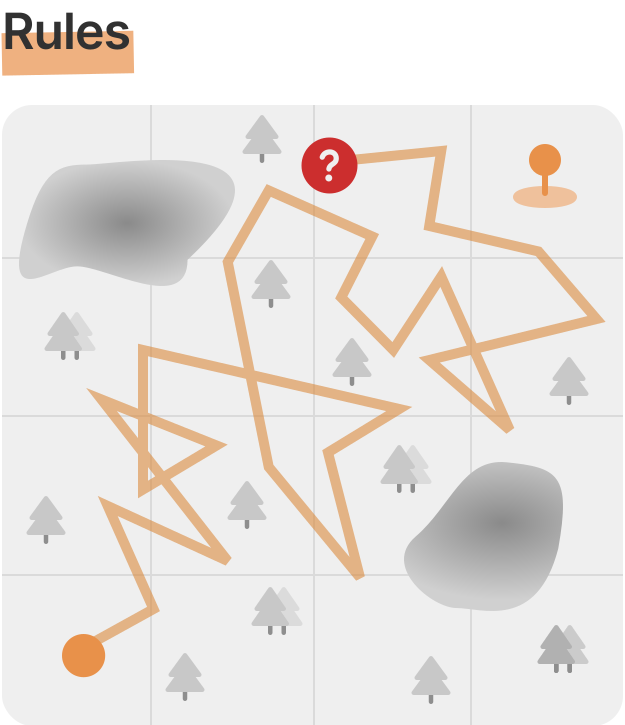
Traditional rule-based systems are built around predefined paths. This shows up in code as the classic if statement: if this happens, do that. Apply this logic, return this output. Rules can make a system repeatable, but they also make it rigid.
Take a reconciliation between accounts payable, the general ledger and the ERP. A rule says IF vendor, date and currency match, THEN reconcile. It breaks the moment a vendor is renamed after a merger, or a contract has a rebate clause that's not reflected in the rules. So, someone adds another IF branch, and the cycle repeats.
Eventually, rules change, more get added, and exceptions multiply. The system becomes a black box that's difficult to understand, update or trust. What was meant to mirror the business starts to lag behind it, until it calcifies, becoming a brittle approximation of reality rather than reality itself.
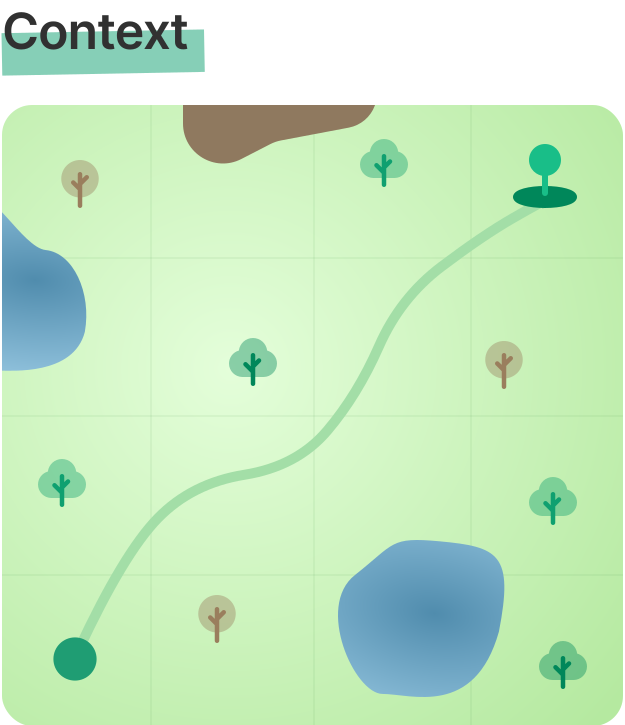
A context-based system works differently. Instead of hard-coding every possible path, it retrieves the information relevant to the question, and uses that context to determine the right outcome. Definitions, policies, business logic, previous decisions and feedback can all be assembled at the point they are needed. Crucially, the system can show which context influenced its judgement, allowing people to challenge, refine and improve it over time—much like working with a trusted colleague.
Ask a context-based system why the same reconciliation doesn't match. It pulls in the vendor history and the contract clause, and explains that spend differs because of the rebate in Contract #4471.
So, we shift from systems that depend on writing rules every time the business changes, to knowledge systems that improve by updating the context they work from.
This doesn't replace consistency with flexibility. It achieves both: a system that can adapt, while remaining traceable, reproducible and reliable.
2. Feedback
A feedback loop is a vital strategic feature that sets modern architecture apart.
People are always learning, but most enterprise data systems are frozen in place. So, there's nowhere to capture that learning, and no way for it to compound. A number gets corrected in a spreadsheet, an assumption is clarified in a meeting, or an exception is resolved in a message. The immediate problem is patched, but the system won't remember. The next person starts from zero, the same problems return, adoption slows, and value creation is limited.
A system with feedback loops behaves differently. Instead of just producing an answer and moving on, it captures the corrections and new context that users provide. If the same problem arises again, that learning is pulled back in, so the system does not start from zero.
This is why the pipeline needs to be context-based. Feedback can be added to the context the system draws on, so we don't need to change the architecture every time something new is learned. While the quality of the context behind each decision improves, the core process stays the same: use the relevant context, apply it to the question, and produce a traceable result.
Over time, value compounds. Every time data is processed, and every correction, exception and decision makes the system more useful for the next person. The system adapts and its behaviour can improve. It gains intelligence, and becomes an Enterprise Brain.
Flywheel for Better Decisions
Think about how many people across an organization make important decisions using data. Finance, procurement, supply chain, legal, commercial, operations and technical teams are all looking for the same strategic lift: to understand what is happening, identify an opportunity, and act while it still matters.
Data is meant to help them do that. In practice, it often gets in the way. Teams have spent years working around static dashboards, fragmented systems and reports they cannot easily question or update. The demand for something better is already there.
A shared context layer and agentic decision layer—an Enterprise Brain—changes everything. It gives the business a way to produce consistent results, capture feedback, and turn each decision into context for the next one. The Enterprise Brain becomes an asset that grows with the business, shaped by the people using it every day.
That is where adoption starts to compound. People contribute to the system, the system helps people make better decisions, and each decision makes it stronger for the next person. Once one team feels the difference, the pull from the rest of the organization quickly follows.
The appetite for transformation is already here, and the technology to make it happen is yours for the taking. Opportunities like this don't happen often, but without the right foundations, AI will only accelerate fragmented ways of working. If you put the foundations in place, it becomes a capability that compounds.
Shameless Plug From a Founder
If you've read this far, thank you for sticking around. I fundamentally believe this is the future of solving enterprise data problems, and the missing key to driving real adoption. I would love to know what you think, even if you'd challenge this approach, and I'm happy to share real-world architecture and adoption examples.
At Deducta, and with our live customers across multiple use cases, we have seen what happens when decisions are structured this way end to end. It changes how an organization operates, what teams expect from their data, and the quality and speed of the decisions they make.
That is why we have become specialists in this problem, and why we love what we do. We have put our money where our mouth is, dedicating our time and our minds to helping companies operate at this level. So, please get in touch if you'd like to chat about what I've spoken about here.