Instinctively, it makes sense that not all revenue has the same value. A pound of annual recurring revenue is worth more because it gives us more confidence in what the business will earn tomorrow. Finance teams have developed a sophisticated language to describe revenue quality. ARR, churn, pricing power and customer concentration help us understand the value behind the top-line number. They tell us whether that revenue is growing, how well it is retained, and how difficult it will be to displace. 'Durability' reigns over all when considering the quality of revenue.
Meanwhile, when we're thinking about cost savings, much of that sophistication disappears. A savings dashboard can show how much cost has been removed, but far less scrutiny is applied to the quality of the saving itself.
As the cost of information decreases across the enterprise (see more of our thinking on decision intelligence) there is a real opportunity for companies to zoom out and think about savings more holistically. Buying teams can evolve from linear category strategies and negotiating spot savings to multidimensional initiatives that broadly consider the price (and risk) of their supply chain.
Not all savings are equal
Imagine three programs that each report £10 million of savings:
- The first cuts or freezes a budget
- The second renegotiates supplier rates using competitor benchmarks.
- The third redesigns the demand and specifications that caused the spend in the first place, while rethinking supplier terms.
The first saving disappears when the freeze is lifted, with much of the spend simply pushed into another period. Worse, a freeze can encourage adverse behavior from the business, like chopping up supplier payments to fall below the procurement threshold.
The second lasts while the new terms are enforced, but depends on continued governance and competitive leverage.
The third changes buying behavior and empowers procurement to play a more proactive, collaborative role within the business. A savings dashboard will show the same £10 million when the quality of those savings is clearly different.
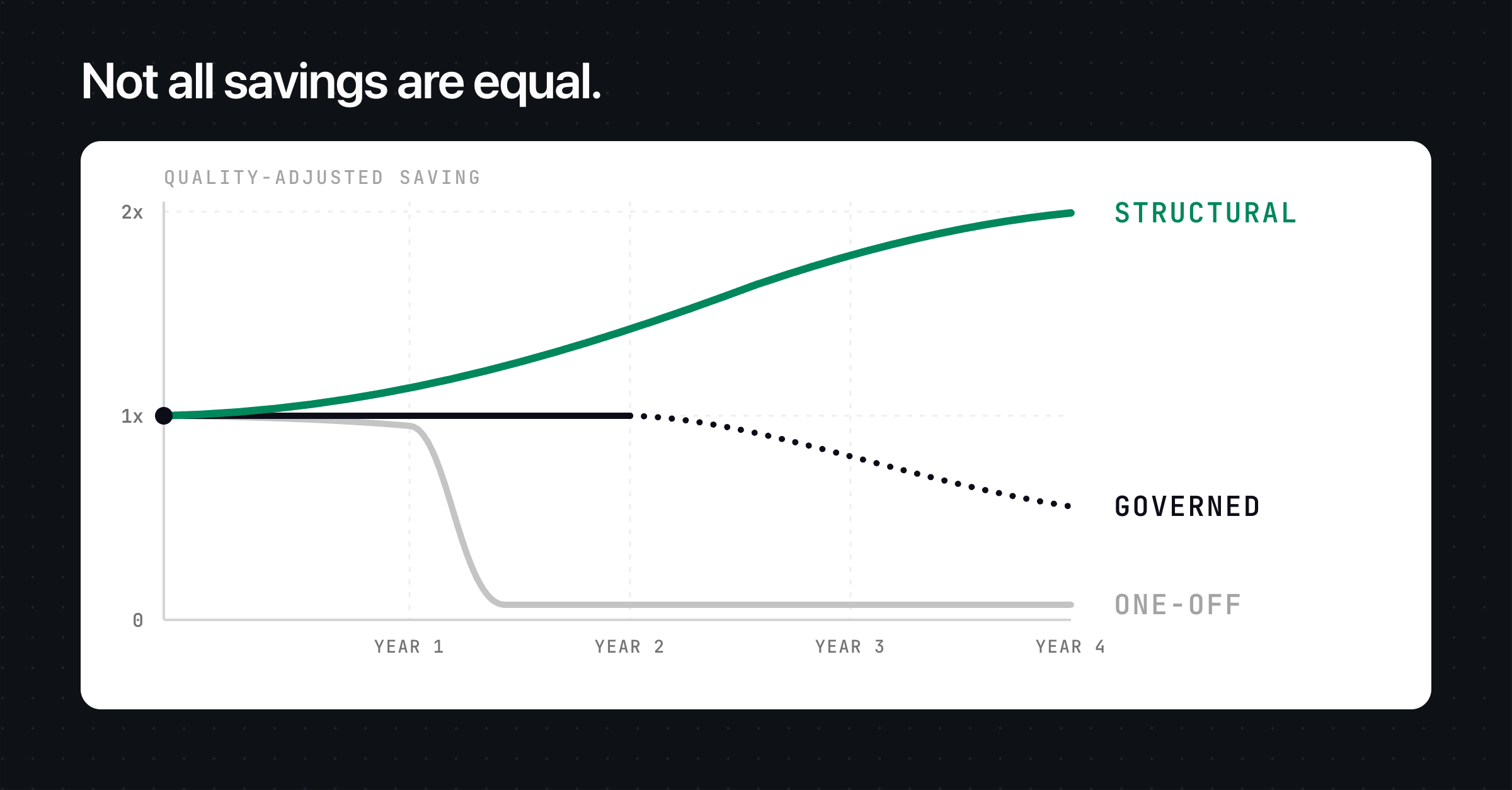
We propose applying different multiples. Finance already does this with revenue, valuing a pound of ARR above a pound of one-off income because it prices in durability and certainty. Applying that same discipline to savings gives finance a comparable, familiar unit that reflects how long the saving should last, what must remain true for it to continue, and how deeply the intervention changes future operations.
Multiplying a reported saving by a durability factor gives a quality-adjusted figure teams can compare across programs and when evaluating strategic options.
| Multiple | Saving | Example | What happens next |
|---|---|---|---|
| 0.5x | One-off | A budget cut/freeze | The saving disappears when the freeze lifts |
| 1x | Governed | A renegotiated supplier rate | The saving lasts while the terms are enforced |
| 2x+ | Structural | A redesign of demand, specification and supply | The change improves the economics of the operation and persists over time |
Illustrative: While this is not a precise formula, it gives a directional signal for savings quality.
We can now level-up how we talk about spend, with a vocabulary that mirrors how we understand revenue. Maverick spend can play a similar role to churn, while savings retention shows whether an intervention lasts, just as net revenue retention shows the durability of recurring revenue.
Don't just spend less, buy better
Paying slightly less for the same product rarely drives the most transformative savings. Unit price is important, but it sits inside a much wider context that includes demand, specification, logistics, inventory, working capital, quality and risk. Optimizing for one variable without understanding the rest can shift spend somewhere else and reduce the effectiveness of any savings initiative.
Take something as simple as a tube of glue. Shaving a few pence from the price may be worthwhile, but it is a low-altitude way of looking at the opportunity. Procurement can go further by asking:
- Why are we buying this glue, in this specification and quantity?
- Why are we using this supplier, packaging and shipping method over another?
- How much inventory are we holding? Why?
- If we switch to a cheaper alternative, will it be compatible with the other materials we use?
- Could the underlying purpose for purchasing glue be designed differently so that we need less of it — or none at all?
Once we can answer those questions, we are starting to think of the price of the supply chain rather than simply the price of a product. That broader view helps procurement understand how a decision affects business throughput, reliability and the capital tied up in the operation. It also shows where a cheaper input may create downtime, waste or quality failures that could wipe out the saving entirely and cost the business more overall.
This is not to say that every saving has to redesign the enterprise to be worthwhile. A freeze may be exactly what a business needs during a liquidity crisis. Renegotiating supplier terms may be the right way to release value quickly. The point is to give visibility to the kind of decisions procurement is making, so that future decisions can be more intentional and strategic. This ultimately creates lasting value for the business. The principle can be applied across direct and indirect spend and as a general ethos for buying teams.
How can you find, measure and prove these opportunities?
Until now, savings quality has been extremely difficult to prove or govern. Savings are booked at the point of negotiation. Meanwhile, leakage, re-spending and recurrence appear later in different systems across different teams. The evidence is fragmented, making it hard to piece together the full story and assess the end-to-end effect.
This is because current spend tools can only tell us what we bought, from which supplier, and for how much. But they don't help us to interrogate the 'why,' or visualize the value of that spend.
Durability can only be observed downstream, in the transaction stream: were the agreed terms actually paid? Did the volume come back? Did the spend reappear under another supplier? Answering that requires a unified, time-series view of spend across every system — an enterprise brain.
Cost cycles reward whoever claims savings fastest, but AI-era intelligence finally makes durability visible and measurable at scale. When spend data is clean and enriched with a reliable context layer across all systems, we can easily interpret the relationships within that spend and where to make improvements.
LLMs allow us to interrogate underlying data in natural language without having to learn another tool or obscure programming language. Everyone on the procurement team can investigate whether agreed terms are followed, how long a saving persists, and where value is leaking. It's easy to model how a decision in one area may affect another part of the business, with reliable evidence, in real time.
Savings quality feeds enterprise value
Cost transformation should be evaluated with the same seriousness as revenue transformation because both affect the quality of earnings. A pound of durable cost reduction goes straight to the bottom line, and is far more within management's control.
A temporary £1 million reduction may be useful, but it has negligible terminal value. A structural £1 million reduction that persists can change expected earnings and release capital, because the business has durably improved the way it operates.
This gives procurement an enterprise-wide imperative. With a full picture of spend and the operations around it, the function can find strategic opportunities, act on them faster, and measure whether the value persists. It can show finance which savings will still exist next year, what could cause them to decline, and where an intervention has created a competitive advantage.
The price of a product tells us what we pay today. The price of the supply chain tells us what buying decisions will cost or create over time. When procurement can make that visible to the business, it showcases the significance of their savings, the quality of spend under their control, and the value they've unlocked across the enterprise.
Over the coming months we'll be digging deeper into some of our thinking here and hearing directly from the leaders pioneering this future.